



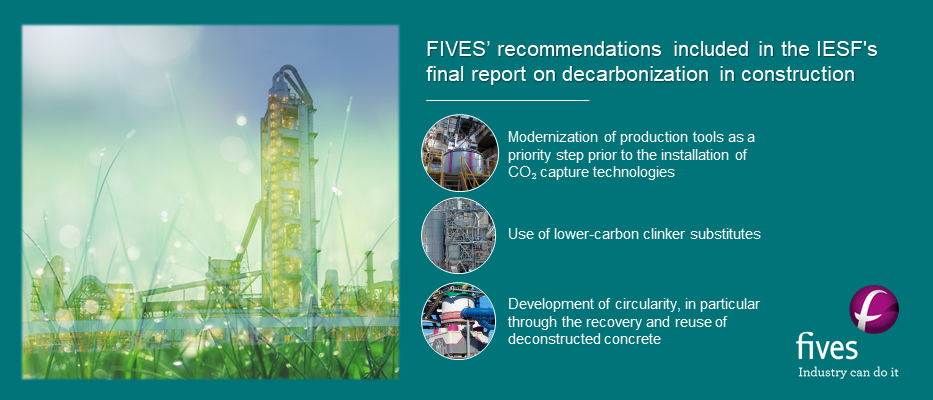
Our recommendations included in the IESF's final report on decarbonization in construction
IESF – Ingénieurs et Scientifiques de France (Engineers and Scientists of France) has launched, as part of its Student Science Convention, a major national project dedicated to decarbonizing the construction industry, particularly cement and concrete. For several months, teams of students from French engineering schools and universities were mobilized to analyze the challenges of the low-carbon transition and propose concrete recommendations for industrial and institutional players.
This initiative, unique in its collaborative approach, aimed to address two key questions:
- Which technological and organizational levers will enable the cement industry to achieve carbon neutrality by 2050?
- Which innovations should be prioritized based on their feasibility, scalability, and carbon impact?
In the Hauts‑de‑France region, students from Polytech Lille, Centrale Lille, and IMT Nord Europe actively contributed to the project, supported by insights from industrial players committed to decarbonization—including Fives.
A structured and recognized contribution
Fives was pleased to contribute to the discussions at the Student Scientific Convention by presenting industrial challenges and solutions already available to reduce the carbon footprint of cement production.
The final report, submitted to the Ministry of Industry, confirms the integration of several recommendations put forward by Fives. These include:
- the modernization of production tools as a priority step prior to the installation of CO₂ capture technologies,
- the use of lower-carbon clinker substitutes,
- the development of circularity, in particular through the recovery and reuse of deconstructed concrete.
These recommendations demonstrate the understanding and relevance of the messages conveyed by our teams and reinforce Fives' visibility among industrial and institutional players.
Fives technologies supporting decarbonization
The inclusion of our recommendations in the IESF report demonstrates the contribution of our technologies to the industry's low-carbon transition. Fives offers a range of proven industrial solutions that simultaneously improve energy efficiency, reduce clinker and promote material circularity.
√ Process modernization and optimization
To help cement plants immediately reduce their emissions, Fives relies on cutting-edge technologies that significantly improve the efficiency of existing lines.
Equipment such as the FCB Horomill® and FCB TSV™ Classifier upgrade grinding plants and reduce energy consumption, while the FCB Preheater and FCB In Line Preca optimize the thermal performance of kiln lines, directly contributing to lower CO₂ emissions.
√ Clinker ratio reduction
Reducing the proportion of clinker in cement is a major lever for decarbonization. The FCB Flash Calciner enables the efficient production of alternative cementitious materials—such as calcined clay—and their integration into cement recipe, thereby supporting lower-carbon production.
√ Circularity and material recovery
In line with the circular economy, Fives has developed FCB Rhodax®, a technology adapted to the recycling and recovery of deconstructed concrete. This equipment enables high-quality materials to be reintegrated into production lines, thereby contributing to waste reduction and the preservation of natural resources.
A collective effort for a more sustainable industry
Participation in the IESF Student Scientific Convention enabled Fives to contribute actively to national reflections on decarbonizing the construction industry, while sharing its vision and expertise with the future engineers who will drive tomorrow’s industrial transition.